


There is a moment in every kitchen where you fill the pot, set it on the burner, and stop thinking about the water entirely.
Yes, you can cook with distilled water, and it is safe. But distilled water has had every mineral stripped out of it, and those minerals do quiet work in your food. Flat stock, slack bread dough, and vegetables that surrender their own nutrients to the pot are all downstream of water with nothing left in it.
- Safe to use: Cooking with distilled water poses no health risk on its own.
- Flavor cost: Mineral-free water tastes hollow, and it passes that hollowness into anything it touches.
- Nutrient cost: Water with no minerals in it pulls minerals out of your food.
- Where it wins: A narrow set of appliance jobs, and only where the manual asks for it.
- The everyday answer: Filtered water, which takes out what you don't want and keeps what you do.
If you are asking this question, you are probably solving a real problem. Maybe your tap water has a swimming pool edge you cannot cook around. Maybe you read your city's water quality report and would rather not think about it again. Distilled water looks like a clean slate.
It is a clean slate. That turns out to be the issue.
What Distilled Water Actually Is

Distillation boils water into steam, then condenses that steam back into liquid in a separate chamber. Minerals and salts have no way to make the trip, so they stay behind. What you collect on the other side is close to pure H₂O, with a total dissolved solids reading near zero.
That is a different thing from boiled water, and a different thing from filtered water. Boiling kills pathogens but leaves every mineral in place, and as some water evaporates it actually concentrates them. Filtration is more selective, pulling out the compounds you don't want while leaving the beneficial minerals dissolved in the water.
Here is how the four options in most kitchens compare:
| Minerals Retained | What It Removes | Taste | Best Kitchen Use | |
|---|---|---|---|---|
| Distilled | None. Near 0 ppm TDS | Minerals and most non-volatile contaminants. Weaker on volatile organics, which can travel with the steam | Flat, hollow | A few specific appliance jobs |
| Reverse osmosis | Very few unless remineralized | Most contaminants and most minerals | Clean but thin | High-contaminant water supplies |
| Carbon filtered | Calcium and magnesium stay | Chlorine and chloramine as standard. Lead, PFAS, microplastics and cysts depending on the block and how it has been tested | Clean and full | Everyday cooking and drinking |
| Untreated tap | Whatever your municipality delivers | Nothing | Varies. Often chlorinated | Depends entirely on your water |
The number worth knowing is TDS, total dissolved solids, measured in parts per million. It tells you how much mineral content is actually in the water. Distilled water sits at essentially zero, and that number explains everything that follows.
What You Lose When You Cook With Distilled Water

Flavor Goes Flat, and It Is Not Your Imagination
Minerals are not a contaminant in your cooking water. They are part of what makes water taste like water. The Specialty Coffee Association's brewing water standard sets a target of 150 mg/L TDS, with an acceptable range of 75 to 250 mg/L. Distilled water sits at zero, well below the floor. Coffee people worked this out because their whole craft lives or dies on water, but you can taste the same principle in a stockpot. Simmer chicken bones for four hours in water with nothing in it, and you get something that should fill the house with Sunday and instead smells faintly of warm nothing.
You will notice it most in the dishes where water is most of what you are eating. Broths, soups, blanching water, rice, oatmeal, tea.
Your Food Gives Its Minerals to the Water
This is the part almost nobody mentions, and it is the strongest reason to keep distilled water out of your cooking. Minerals move from where they are concentrated toward where they are not. Your food is full of them. Distilled water has none at all. That gradient is at its steepest in mineral-free water, so more of what was in the food ends up in the pot.
The World Health Organization measured how much. In its review Nutrients in Drinking Water, cooking in soft, low-mineral water caused losses of up to 60% of magnesium and calcium from vegetables, meat, and cereals, with higher losses for some trace elements, including 66% of copper, 70% of manganese, and 86% of cobalt.
So the green beans come out of the pot a little emptier than they went in. Not dangerously so, and not in a way you would taste on a single Tuesday. But you bought those beans partly because they were good for you, and some of that is going down the drain with the cooking water.
Bread and Dough Turn Slack
Bakers have paid attention to water minerality for a long time, because dough tells on you immediately. King Arthur Baking recommends water of medium hardness, around 100 to 150 ppm of minerals, for bread, and defines soft water as anything under 50 ppm. The minerals in your water feed the yeast during fermentation. Get the balance wrong in either direction, and the dough lets you know: too few minerals and it turns sticky and slack under your hands, too many, and the gluten tightens while fermentation slows down.
Distilled water is not merely below 50 ppm. It is at zero, well outside the range on the low side. If your loaves have gone mysteriously flat and you recently switched water, you have found your culprit.
Coffee and Tea Under-Extract
The same standard calls for total chlorine at 0 mg/L and calcium hardness around 68 mg/L. Both numbers matter. Chlorine dulls aromatics, and dissolved minerals actively help pull flavor compounds out of the grounds or the leaves. Brew with distilled water and extraction suffers. The cup comes out thin and sour instead of sweet and full, no matter how good the beans were.
Is It Safe to Cook With Distilled Water?

Yes. There is a persistent claim online that distilled water "leaches minerals from your body," and the social media version of it is badly overstated. It is not invented, though. The same WHO review notes that low-mineral water increases the elimination of calcium and magnesium from the body, and it records a formal warning from the German Society for Nutrition against drinking distilled water.
Dose and duration are doing the work in that finding. Cooking a pot of pasta in distilled water will not harm you, and neither will drinking a glass of it. If distilled water becomes the only water you ever drink and cook with, over a long stretch of time, you are removing a small but real dietary source of calcium and magnesium, and the food-mineral losses above stack on top of that.
That is a nutrition question about a long-term pattern, not a safety question about tonight's dinner. Occasional use is fine. Building your whole kitchen around it is worth deciding on purpose.
When Distilled Water Is the Right Call in the Kitchen
There is a narrow set of jobs where zero minerals is exactly the point. In each of them, the enemy is limescale rather than flavor, and the water never becomes part of anything you eat.
- When the manual specifically asks for it: Check before you assume. Plenty of the appliances people reach for distilled water to protect actually specify filtered or softened water instead, and some warn against distilled outright. Espresso machines are the common example. Many use conductivity-based water level sensors that distilled water cannot trigger, and the same aggressiveness that makes it good against scale is hard on boiler metal over time.
- Electric kettles in very hard water homes: If you are descaling every month, this is where distilled water genuinely earns its keep.
- As a blank canvas for controlled brewing: Some coffee obsessives start with distilled water and add a measured mineral packet to hit an exact TDS target. The point is not the distilled water. It is the control over what goes back in.
- Humidifiers and steam irons: Not cooking, but the same logic. No minerals means no white dust and no clogged vents.
That is close to the whole list. For anything that ends up on a plate, the math runs the other way.
Why Filtered Water Is the Better Everyday Choice for Cooking

The goal was never pure water. It was clean water. Those are two different targets, and distillation solves for the wrong one. Distillation fixes the problem by removing everything. Filtration removes the specific things you don't want and leaves the rest alone. In a kitchen, that distinction is the whole argument.
What a carbon block water filter can address, depending on the specific filter and what it has been independently tested to do:
- Chlorine and chloramine: The reason your tap water tastes and smells like a swimming pool. This is the baseline job of any carbon filter.
- Lead: Which enters after treatment, from aging service lines and older household plumbing.
- PFAS: The synthetic compounds that do not break down on their own.
- Microplastics: Increasingly documented in municipal supplies.
- Cysts: Cryptosporidium, which is genuinely chlorine-resistant, and the more chlorine-tolerant Giardia.
- VOCs, herbicides, and pesticides: Industrial and agricultural runoff.
And unlike distillation, filtration leaves in the calcium and magnesium, doing all the work described above.
Published test results are the thing to actually read here, because "filter" covers an enormous range. Look for a filter that names the standards it was tested against and shows you the reduction figures it actually achieved, and be wary of any that lists impressive-sounding contaminants without saying what was measured.
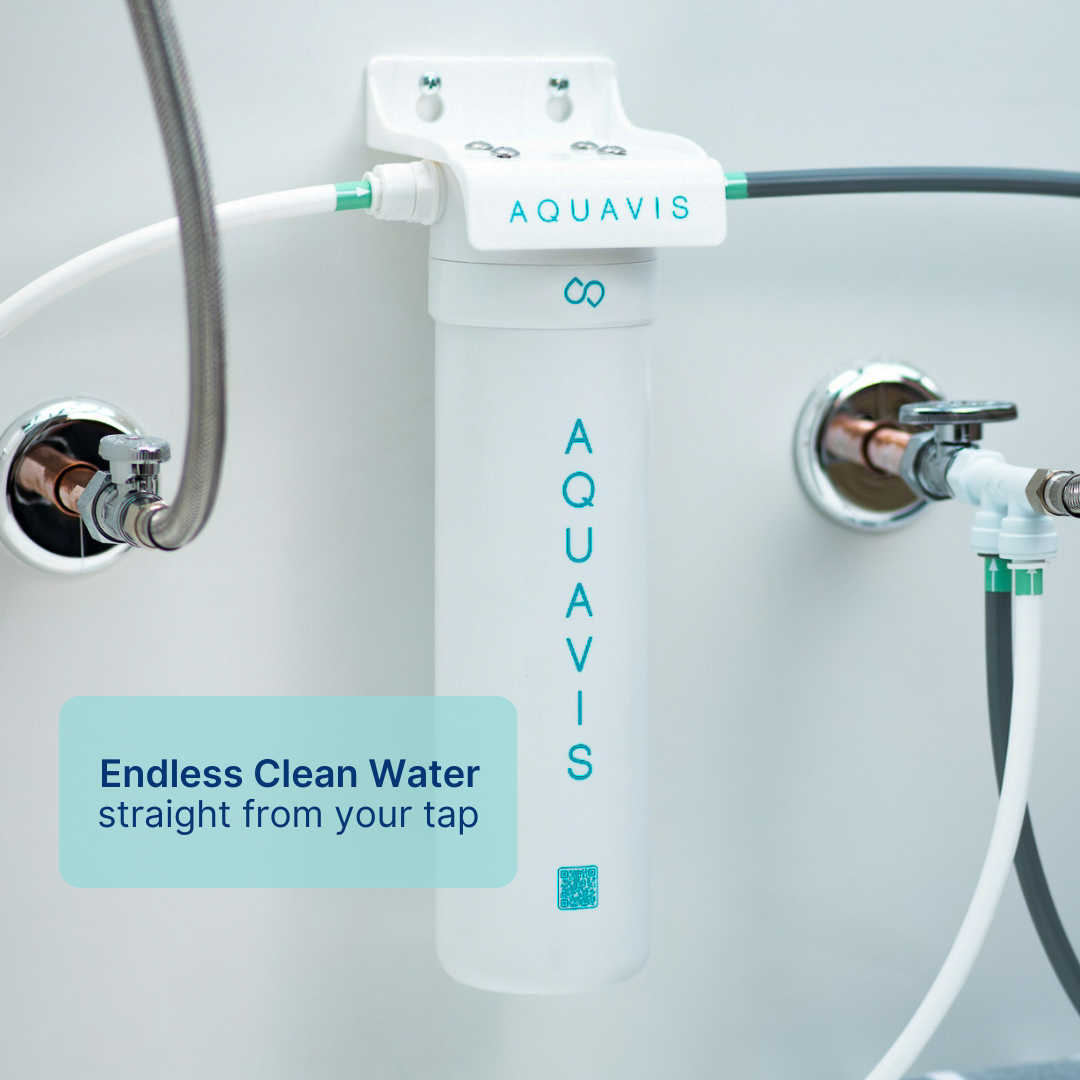
The Aquavis Pulse 10 is built around this exact trade-off. It is a catalytic activated carbon block that filters down to 0.5 microns, tested by an independent laboratory against the NSF/ANSI 42, 401, and 372 standards. In that testing, it reduced chlorine by 98.90%, chloramine by 92.60%, microplastics by 98.90%, and lead by 93.90%.

It does all of that while deliberately leaving the beneficial dissolved minerals in your water rather than stripping them out. One cartridge covers about 750 gallons, which is roughly six months for most households, and it installs under the sink in about fifteen minutes with no plumber.
Chlorine Is a Flavor Problem, Not Just a Safety Problem
Your city adds chlorine for a good reason. It kills the bacteria that once made drinking water from your kitchen tap genuinely dangerous, and it is a large part of why you can fill a glass without thinking twice. It is also the single biggest reason that glass of tap water tastes the way it does.
Chlorine and chloramine flatten aromatic compounds. They dull the top notes in coffee and tea and mute the vegetal sweetness in blanched greens, the bright green snap you were hoping for when you salted the water. The target of 0 mg/L total chlorine in the coffee standard is not a safety threshold. It is a flavor threshold.
It is also the easiest thing on that whole list to fix. Chlorine and chloramine are exactly what activated carbon is best at, which is why a filter can take out nearly all of it at the sink without touching the calcium and magnesium sitting right next to it in the same glass.
Take out the chlorine and keep the minerals, and you get what you were actually reaching for when you picked up that jug of distilled water. You wanted the chlorine gone. You did not mean to take the magnesium with it.
The Other Half of a Clean Kitchen: What Your Cookware Puts Back

Once you have thought carefully about what is dissolved in your water, there is one more thing touching every single meal, and it is the pot itself. The same WHO review that measured mineral loss from food made a second point worth carrying into the kitchen. Low-mineral water, it noted, is unstable and "highly aggressive to materials with which it comes into contact," dissolving metals and other substances more readily than mineralized water does. That was written about municipal pipes and storage tanks, not saucepans, and the effect at kitchen scale is small. But it makes the material your dinner actually cooks in worth a real thought rather than an afterthought.
For everyday cooking, the materials that hold up over years of daily use are well established:
- Stainless steel: Non-reactive, handles acidic ingredients without giving anything a metallic edge, and survives high heat and dishwashers indefinitely.
- Enameled cast iron: A glass-like enamel fused over iron. Excellent heat retention, no seasoning required, and nothing reactive touching your food.
- Carbon steel: Responsive to heat changes, builds its own natural nonstick patina as you cook on it, and rewards you for paying attention.
Any of these will outlast a decade of use, which is the measure that matters. A pan you replace every eighteen months costs more than a good one, and there is a particular satisfaction in reaching for cookware you know will still be in the drawer when your kids are cooking their own dinners in it.
If You Are Avoiding Synthetic Coatings

If you filtered PFAS out of your water, you probably want the same scrutiny applied to your pans, and that instinct is worth following. Start with ceramic nonstick cookware. Ceramic coatings are built on a silica and metal-oxide sol-gel rather than a fluoropolymer, which is a different chemistry from traditional nonstick. Formulations vary by manufacturer, so this is a spec sheet question rather than a category guarantee. Look for a line that states it is made without intentionally added PTFE, PFOA, PFAS, lead, and cadmium, and be skeptical of anything that gestures at "non-toxic" or "chemical-free" without naming the specific compounds it leaves out.
Ceramic surfaces do best over low to medium heat with silicone, wood, or nylon utensils. Treat yours that way and the release stays effortless for years.
Frequently Asked Questions About Cooking With Distilled Water

Can you cook pasta with distilled water? Yes, though pasta water is where you will notice it most. The starchy water you reserve for finishing a sauce tastes noticeably flatter. Salting the pot adds sodium chloride back, but it does not replace the calcium and magnesium that distillation removed.
Can you use distilled water to cook rice? Yes, and rice is a case where your water matters more than most. Rice absorbs nearly all of its cooking water, so whatever is in that water ends up in the grain. That argues for filtered water over both distilled and untreated tap. You get the contaminants out without cooking your rice in a mineral vacuum.
Is distilled water just boiled water? No. Boiling kills pathogens but leaves the minerals behind, and evaporation actually concentrates them. Distillation captures the steam and condenses it somewhere else, which is what leaves the minerals behind.
Do you need to refrigerate distilled water after opening? No. Keep it capped and stored at room temperature, out of direct sunlight. Because distilled water is such an effective solvent, an open container slowly absorbs carbon dioxide from the air and picks up traces of whatever it is stored in, so a sealed container matters more than a cold one.
Does distilled water boil faster? Not in any way you could measure. Dissolved minerals raise water's boiling point by a few hundredths of a degree at typical tap water levels, so distilled water technically reaches boiling a hair lower. It also has fewer nucleation sites for bubbles to form on, which works in the opposite direction. On your stovetop, the two cancel out into nothing.
Is distilled water safe to drink every day? It is safe in the short term, but it is not ideal as your only source. You lose the small dietary contribution of calcium and magnesium that mineralized water provides. Filtered water gives you clean water without that trade-off.
Cook With Water You Can Trust

You can cook with distilled water. For a kettle in a hard-water house, or an appliance whose manual asks for it, it is the right call.
For everything that ends up on a plate, it costs you more than it gives. Flavor flattens, dough goes slack, coffee thins out, and your food quietly hands over its own minerals to a pot of water with room to take them. None of that shows up in one meal. It shows up across a year of them.
What you actually want is water with the chlorine, lead, PFAS, and microplastics taken out and the calcium and magnesium left in. That is filtration, not distillation, and it fits a kitchen far better. Fill the pot without thinking about it, and let the stock taste like the bones you put in it.
See how the Aquavis Pulse 10 handles both sides of that, and get it under your sink this afternoon.